Castor oil has been used for centuries in healing, skincare, haircare, and Ayurvedic therapies. Many people experience remarkable benefits from castor oil, relief from skin concerns like eczema and psoriasis, improved hair shine, reduced acne, joint pain comfort, and support in constipation.
At the same time, many people say castor oil did nothing for them or caused irritation.
The reason is simple:
👉 All castor oils available in the market are NOT the same.
If you don’t know how to read the label or understand the extraction method, the oil can turn from a remedy into a problem. A bottle that says “100% natural” does not automatically mean it is safe, therapeutic, or suitable for application.
That is why it is essential to understand which type of castor oil is right for you and how it should be used correctly.
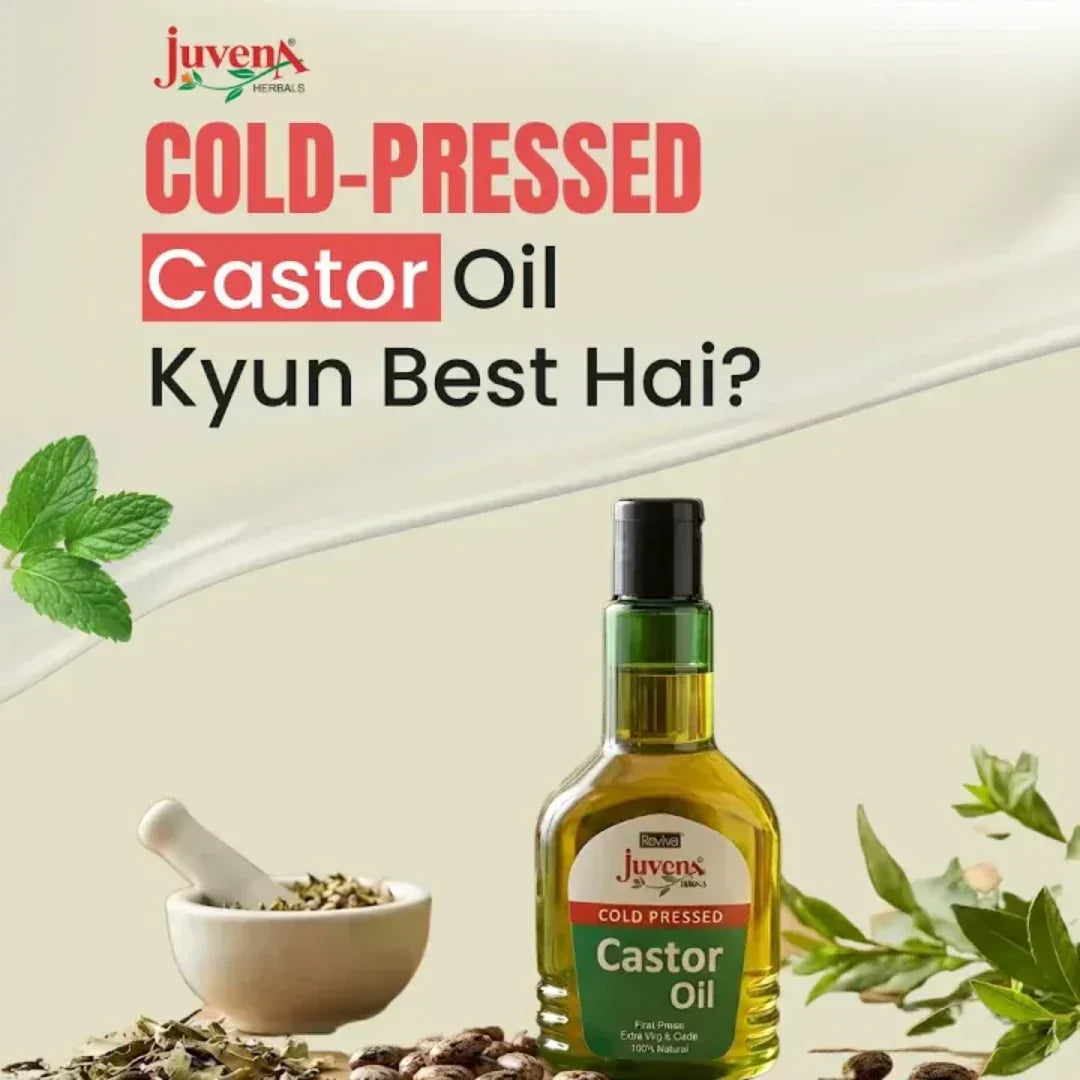
Juvena Herbals Presents Cold-Pressed, First-Press Castor Oil
Juvena Herbals presents Cold-Pressed, First-Press Castor Oil, extracted using methods that preserve purity, clarity, and therapeutic value. This quality of castor oil is suitable for skin treatments, scalp therapies, Ayurvedic applications, and therapeutic use when applied correctly.
Types of Castor Oil Based on Extraction Method
1. Cold-Pressed Castor Oil
Cold-pressed castor oil is extracted by sun-drying cleaned castor seeds and crushing them using wooden or steel plates without applying heat. This method helps retain the oil’s natural properties.
First-Press Cold-Pressed Castor Oil
-
Clear appearance
-
Light, pale color
-
Good thickness and viscosity
-
Contains approximately 90% ricinoleic acid
-
High therapeutic quality
-
Better shelf life compared to second press
Used for:
-
Hair treatments
-
Scalp therapies
-
Skin treatments
-
Ayurvedic and therapeutic applications
-
Joint discomfort
-
Constipation (under guidance)
-
Navel therapy
-
Acne care
This is the most preferred form of castor oil for personal and therapeutic use.
Second-Press Cold-Pressed Castor Oil
-
Darker and cloudy appearance
-
Less clarity
-
Short shelf life
-
Spoils faster
Although still usable, first-press oil is always recommended due to higher stability and clarity.
2. Hot-Pressed Castor Oil (Expeller Method)
This oil is extracted using machines that generate high heat through friction.
Characteristics:
-
Dark color
-
Burnt smell
-
Significant nutrient loss
Used for:
-
Industrial lubricants
-
Soap manufacturing
❌ Not suitable for skin, hair, or consumption
3. Hexane / Solvent Extraction Method
In this method, chemical solvents are mixed with castor seeds to extract oil.
Characteristics:
-
High quantity yield
-
Nutrients reduced to zero
-
Possible chemical residue
Used for:
-
Paints
-
Varnish
-
Industrial purposes
❌ Not safe for skin, scalp, body therapies, or oral use
4. RBD Castor Oil
This oil is heavily refined to improve appearance and shelf life.
Characteristics:
-
Looks clean and attractive
-
No natural smell
-
Very long shelf life
-
Zero nutritional value
Used for:
-
Lipstick manufacturing
-
Pharmaceutical excipients (tablet binding)
❌ Not suitable for therapeutic or cosmetic application
5. Traditional Ayurvedic Method
In this traditional process:
-
Seeds are cleaned, dried, and crushed
-
Mixed with water
-
Slowly heated until water evaporates and oil separates
Characteristics:
-
Oil is not crystal clear
-
Shelf life is very short (10–15 days)
-
Retains around 90% ricinoleic acid
Used under medical supervision for:
-
Navel therapy
-
Panchakarma
-
Basti therapies
-
Severe, chronic constipation
Why Cold-Pressed, First-Press Castor Oil Is Preferred
Both cold-pressed first-press oil and traditional Ayurvedic oil provide similar therapeutic yield.
However, cold-pressed first-press castor oil is:
-
More convenient
-
More stable
-
Easier to store
-
Equally effective
How to Use Castor Oil Correctly
Castor oil is heavy and highly viscous. Applying it directly can cause:
-
Scalp clogging
-
Itching and irritation
-
Skin congestion over time
That is why castor oil should always be diluted.
Using Castor Oil with Spa Silk Oil, Beauty Oil & Healing Oil
-
Spa Silk Oil:
Already contains castor oil. You can increase the castor oil quantity in it for therapies, but do not consume it orally. -
Beauty Oil:
Adding castor oil enhances smoothness and improves the brightening effect. Castor oil helps other ingredients penetrate deeper into the skin, giving faster and better results. -
Healing Oil:
When mixed with castor oil, it becomes more effective for joint discomfort and therapeutic body care.
If these oils are not available, olive oil or sesame oil can be used as carrier oils.
Correct Mixing Ratios
-
General skin & body care:
2 parts carrier oil : 1 part castor oil -
Severe joint discomfort, psoriasis, eczema:
1:1 ratio -
Scalp concerns:
3:1 or 4:1 (carrier oil : castor oil)
This dilution prevents clogging and irritation while allowing castor oil to work effectively.
Final Words
Castor oil is one of the most powerful and intelligent oils, but only when used with correct knowledge.
When you understand:
-
Extraction method
-
Oil quality
-
Proper dilution
This oil transforms from a risk into a true therapeutic blessing.
Use castor oil wisely, and it will always support your skin, hair, and body naturally.
Watch Full Video- https://youtu.be/ygV27mOnH_U?si=V8MdrG4OS-buLe1k
𝐅𝐨𝐫 𝐅𝐑𝐄𝐄 𝐒𝐤𝐢𝐧 𝐚𝐧𝐝 𝐇𝐚𝐢𝐫 𝐂𝐨𝐧𝐬𝐮𝐥𝐭𝐚𝐭𝐢𝐨𝐧-
𝐖𝐡𝐚𝐭𝐬𝐀𝐩𝐩 𝐮𝐬 𝐨𝐧
𝐨𝐫
𝐂𝐚𝐥𝐥 𝐮𝐬 𝐨𝐧: +𝟗𝟏 𝟗𝟒𝟏𝟓𝟐𝟖𝟐𝟒𝟎𝟕